
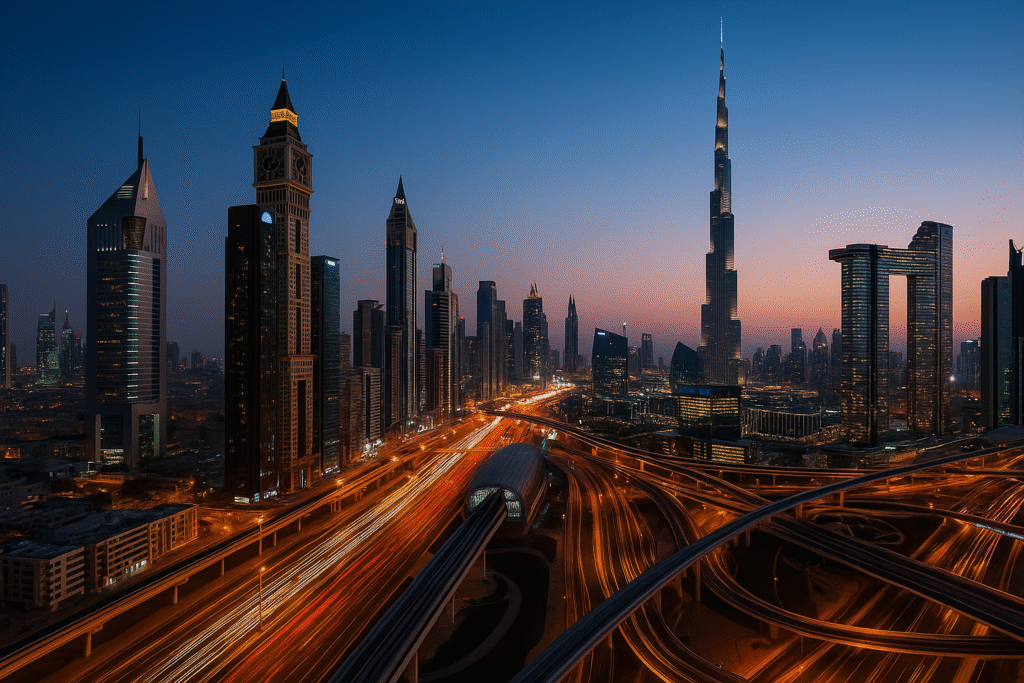
Dubai’s ambitious dedication to building world-class Leading Infrastructure has turned it from a trading port in the desert into a global city. Dubai is a magnet for investors because of its world-class freeways, airports, and smart city utilities, which are the backbone of its real estate boom. The officials of the emirate have always said that building Leading infrastructure is important for the economy and the property market. The UAE is now one of the best countries in the world for infrastructure quality. In fact, it’s the best country in the world for road and highway satisfaction. This blog talks about why infrastructure is important in real estate, how Dubai went from sand to skyscrapers, and the big projects and initiatives that are driving real estate expansion across the UAE.
Why Infrastructure Matters in Real Estate
Infrastructure is what keeps property values high. Paved roads, public transportation, and utilities make it much easier to get around and live in an area. These are all things that immediately lead to greater property values and demand. Studies from all over the world show that well-planned infrastructure makes real estate worth more. Dubai’s strong infrastructural network draws in businesses and people from around the world, which raises the demand for rentals and property investments. Reliable utilities and municipal facilities increase people’ quality of life, while excellent connections (from highways to Metro lines) make the area more appealing and minimize commutes. All these characteristics contribute to stability and long-term economic growth, resulting in steady property value appreciation. Infrastructure improves neighborhoods, making them more appealing to homeowners and investors.
Dubai’s Journey to World-Class Infrastructure
The story of Dubai’s infrastructure is truly remarkable. This city had less than 50,000 people in the 1960s, and it depended on fishing and pearling. The discovery of oil in 1966 led to quick growth. Leaders like Sheikh Rashid bin Saeed Al Maktoum had the idea to use oil money to build modern roads, ports, and airports, which helped make Dubai a global city. The World Trade Center was Dubai’s first skyscraper, and it stood alone in the sand by 1979. In the 1980s and 1990s, there were giant projects, including building Sheikh Zayed Road (finished in 1980), Jebel Ali Port (today one of the world’s largest man-made ports), and starting Emirates Airline, which connected Dubai to the rest of the globe. As the 2000s rolled around, the skyline was filled with huge new buildings. Dubai was such a busy place for building in 2006 that an estimated 25% of the world’s cranes were working there at the same time. This graph shows how quickly the city was growing. Today, Dubai has more than 3.5 million people, its built-up area has grown 170 times since 1960, and its infrastructure is on par with that of the world’s most advanced cities.
Landmark Infrastructure Projects That Define Dubai
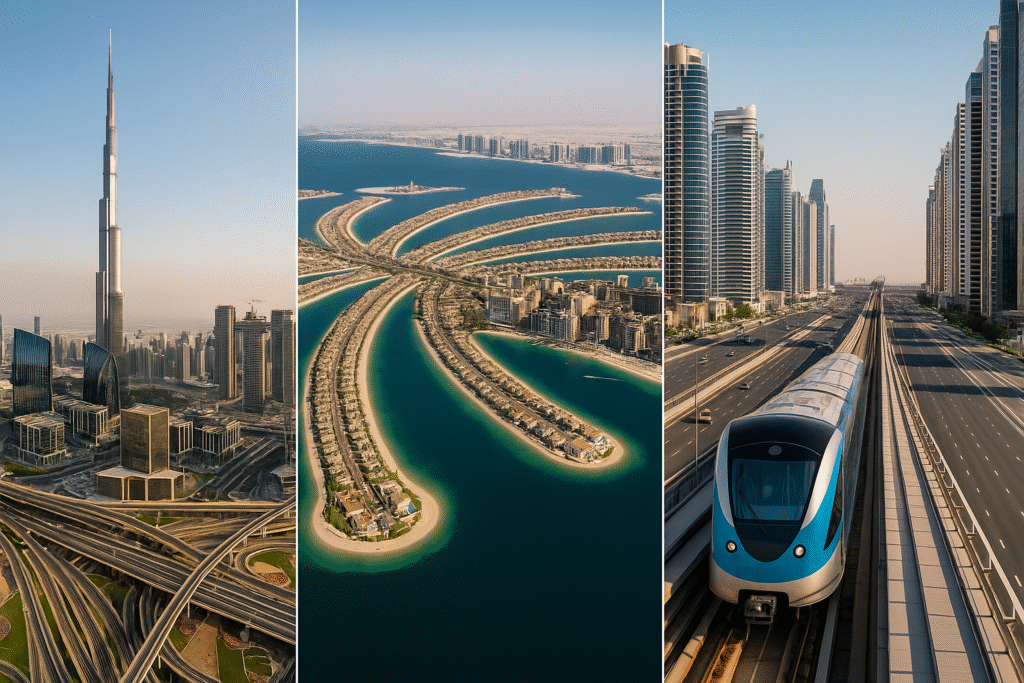
Dubai’s landscape is studded with visionary projects that showcase its leading infrastructure and drive real estate growth:
- Downtown Dubai & Burj Khalifa District: The Burj Khalifa District and Downtown Dubai are a 2 km² master development that cost about $20 billion. It is an engineering wonder. The Burj Khalifa, which is 828 meters tall, is the highest building in the world. – it also has the Dubai Mall, which has more than 1,300 retailers and 100 million people a year. This neighborhood’s combination of record-breaking attractions, business centers, and high-end homes has set the norm for urban development, raising property values in and around “the Center of Now.”
- Palm Jumeirah: Palm Jumeirah is a palm tree-shaped artificial island that adds 56 kilometers of shoreline to Dubai. It is a symbol of innovation. It was finished in the middle of the 2000s and built new seaside neighborhoods with luxury homes, resorts, and apartments. More than 25,000 individuals live in the Palm now. The project’s success elevated Dubai’s real estate status abroad, demonstrating that even the sea could transform into luxurious property. Because of its unique location and features, homes on the Palm have always been more expensive than homes in other areas.
- Dubai Metro: The driverless Dubai Metro opened in 2009 and connects important areas from the airport to the Marina across 90 km and 50+ stops. It was the Middle East’s first metro of its kind and has served hundreds of millions. The Metro’s Red and Green Lines not only made traffic easier, but they also led to transit-oriented developments near stations. Property values in neighborhoods close to Metro stops rose more than average, which is a strong sign of how infrastructure affects real estate. For instance, from 2010 to 2022, homes within a 15-minute walk of Metro stations went up 26.7%, which is more than the citywide average of 24.1%.
- Expo City Dubai (formerly Expo 2020 site): which used to be the site of Expo 2020, is a small city in the south of Dubai that was built for the event. The location will become Expo City, a 3.5 km² smart city that will have 35,000 residents and 40,000 workers after the Expo. It keeps 80% of the Expo infrastructure, like the Al Wasl Plaza dome and modern pavilions that are now offices, museums, and campuses. Expo City Dubai is eco-friendly and walkable, aligning with the emirate’s future goals. This giant project has already improved the area around Dubai South, creating a new hub of innovation and increasing the need for housing and business space.
- Dubai Creek Harbour: Located along the historic creek across town from Downtown, Dubai Creek Harbour is a new waterside community that will change the way people live in luxury. This development covers 6 square kilometers, which is almost twice the size of Downtown Dubai. It will have big parks, promenades, and infrastructure planning on a large scale. The Dubai Creek Tower, a futuristic spire that might soar more than 1,300 meters and possibly top the Burj Khalifa, will be the main attraction. Creek Harbour’s promise of sophisticated residences with views of the skyline and wildlife refuge drew investors even before its completion. The project will make a new real estate hotspot by combining city life with natural beauty. It will have a huge mall (Dubai Square) and several residential areas.
Each of these famous buildings has become a symbol of Dubai and has also helped the property markets around them grow. They show how creative infrastructure can turn formerly underdeveloped places into booming investment zones by creating whole ecosystems of value.
How Leading Infrastructure Boosts Real Estate Investment
The Dubai Metro on elevated tracks is an example of how good infrastructure can raise property values. Investors in Dubai have seen for themselves how infrastructure growth can lead to a high return on investment (ROI). Modern transportation and utilities make a city more “livable” by turning remote locations into attractive real estate once they are connected. The “Metro effect” is a positive example. Research shows that residences near Dubai Metro stations did far better than the market as a whole. Prices citywide went up by about 24% from 2010 to 2022, but prices within 15 minutes of a station went up by 26.7%. In the same way, rental prices in those well-connected neighborhoods went up by 5.7%, even though rentals were low in other parts of Dubai. The increase gave landlords in those neighborhoods a big advantage. This outperformance shows how much tenants and purchasers value convenient commutes and access to public transportation.
Infrastructure projects also tend to create anticipation effects. Investors sometimes rush to buy property in regions where a new highway, airport, or rail line is planned, hoping that prices will go up. For instance, better road interchanges or new schools and hospitals in a suburb might quickly make its real estate more valuable. In addition to short-term price increases, good infrastructure helps a city stay strong and appealing, which leads to long-term ROI. During downturns, properties in well-developed, well-connected neighborhoods keep their value better and recover faster. Dubai’s economy has become more diverse since the government keeps spending money on infrastructure (ports, free zones, tech centers, etc.). This makes the real estate market more stable and gives investors more confidence.
Dubai’s Vision 2040 – The Future of Smart Infrastructure
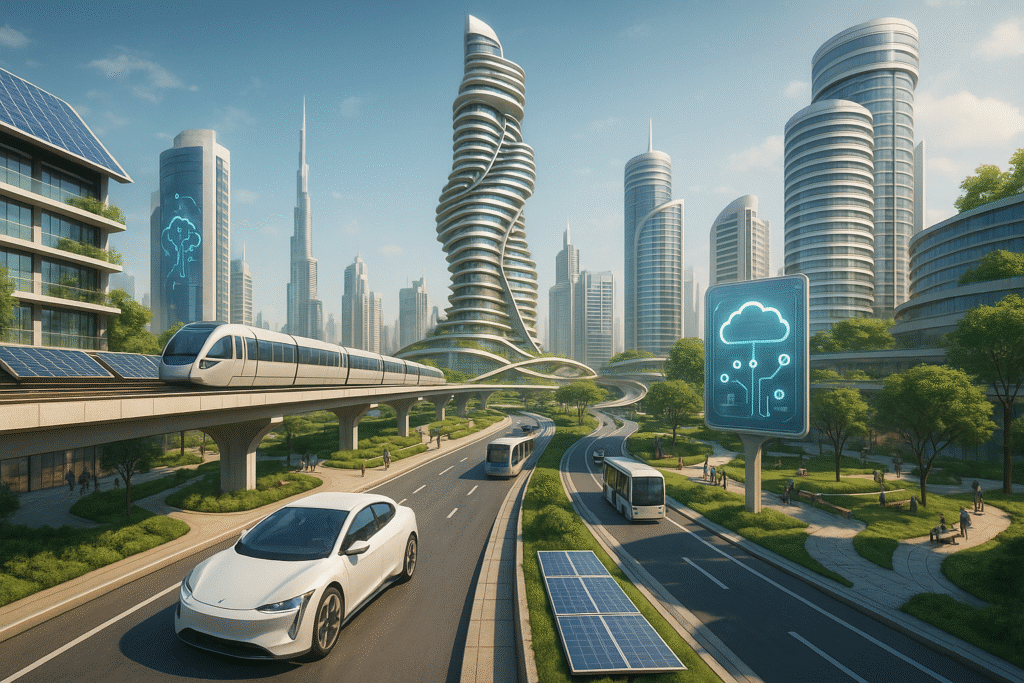
Dubai’s Vision 2040 Urban Master Plan lays out a bold plan for a smart, green metropolis of the future. This plan focuses on development that puts people first. Its goals are to have 55% of the population live within walking distance of public transportation and green spaces. The construction of “20-minute city” rules is one of the main goals. These policies aim to make it possible for most everyday needs and amenities to be reached within 20 minutes by foot or bike. Dubai is spending money on next-generation mobility to make these developments happen. By 2029, there will be a new Metro Blue Line that is 30 km long and has 14 stops. There are also plans to expand driverless trams, water taxis, and cycling networks. Smart technology will be the basis for managing infrastructure. For example, authorities are using AI-powered traffic control and IoT sensors to make everything from traffic jams to energy use more efficient. The city also has a daring plan to make 25% of all trips driverless by 2030. This would start a new era of self-driving cars, shuttles, and even aerial taxis.
Another important idea in Vision 2040 is sustainability. The plan says that the amount of parks and open land should double, the length of public beaches should quadruple, and 60% of Dubai’s territory should be kept as natural reserves. The “Green Spine,” a network of linear parks and bike routes, is one of the big projects that will connect neighborhoods and lower the temperature in cities. All new buildings will meet strict ecological requirements, using a lot of solar energy, recycled water, and materials that are beneficial for the environment. Dubai is adding clean energy sources, including the Mohammed Bin Rashid Solar Park, and electric car infrastructure all throughout the city to meet the UAE’s Net Zero 2050 goal. In short, the Dubai of 2040 will be a smarter, greener city where technology and sustainability come together to improve life. By thinking ahead, this method makes sure that real estate development keeps up with the demand for “smart homes” in “smart districts” that future purchasers and renters would want.
Why Investors Trust Dubai’s Infrastructure Ecosystem
Investors from all over the world trust Dubai because it has a demonstrated track record of building infrastructure and solid governance. The government’s strategic vision—from the earliest master plans to the present Dubai 2040 goal—provides clarity and confidence that infrastructure will continue to lead expansion (and not lag behind it). The UAE consistently leads global infrastructure standards, demonstrating its commitment. In 2023, it was at the top of global rankings for road quality, energy infrastructure, and city administration, showing a level of excellence that few emerging countries can match. Investors are less likely to lose money since they know that properties in Dubai come with reliable power, water, telecom, and transport links.
The government’s pro-investor policies also help with infrastructure. Long-term residency visas (the UAE Golden Visa program) for property owners and investors are examples of how infrastructure growth and investment incentives can work together. When new economic free zones, commercial districts, or tourist regions are declared, the government often backs them up with rules that make them more appealing, like allowing 100% foreign ownership or tax breaks. This creates whole ecosystems that attract both firms and customers. Dubai’s dynamic urban planning also provides investors with a sense of security. When some parts of the city get too hot or have too much traffic, the city quickly fixes the problem by building new bridges or extending the metro or by opening up new development lanes. The outcome is a city that is both lively and well-organized. Demand is still strongest in areas with better connectivity, and Dubai’s ability to constantly update its infrastructure means that new “connected zones” keep popping up. From the Marina to Business Bay to new hubs like Creek Harbour, investors have many choices, and they can be sure that Dubai’s strong infrastructure will support each one. In summary, Dubai’s infrastructure leadership significantly contributes to its reputation as a secure investment destination in the future. This fosters trust and motivates both local and foreign investors to purchase real estate in the city.
Final Thoughts
Dubai’s rise from s/and dunes to skyscrapers shows a basic truth: good infrastructure is the key to its real estate growth. Dubai has built an urban environment where property values rise and global investors pay attention by putting money into imaginative projects like man-made islands, super-tall structures, metros, and smart cities. The city’s world-class infrastructure doesn’t just make skylines; it also gives people confidence. Infrastructure is turning Dubai into a real estate investor’s dream. For example, smooth travel on modern highways, easy navigation on the metro, and the attractiveness of well-planned coastal developments contribute to this transformation. As the emirate moves toward its 2040 vision, new opportunities are appearing alongside tech-driven, environmentally friendly growth.
Want to be a part of Dubai’s growing story? Check out our Why Dubai guide and other resources to learn more about our carefully chosen properties in well-connected neighborhoods. Our staff at Seen Properties can help you take advantage of Dubai’s amazing infrastructure and thriving real estate market, whether you’re searching for a house or an investment. Get in touch with us immediately to find the greatest listings, get individual guidance, and feel confident about the future of Dubai real estate.
Frequently Asked Questions (FAQs)
Q: Why is infrastructure so important for real estate values in Dubai?
A: Infrastructure makes places more desirable by making them easier to go to and connect. Dubai has world-class roads, public transportation, airports, and utilities that make living much better. This enhanced quality of life draws in more people and businesses, which raises the demand for homes. Research has demonstrated that infrastructure has a direct effect on property values. For example, homes near the Dubai Metro gained value faster than those farther away because they were easier to get to. In short, excellent infrastructure makes a city’s “effective locations” bigger, turning areas that were once far away into ideal real estate.
Q: What major infrastructure projects are driving Dubai’s real estate growth?
Some of the most important projects are the building of Downtown Dubai (including Burj Khalifa and Dubai Mall), the Palm Jumeirah island, the Dubai Metro network, and big projects like Expo City Dubai and Dubai Creek Harbour. Downtown Dubai made a new high-value urban core; Palm Jumeirah added kilometers of prestigious beachfront real estate; the Metro connected neighborhoods far away from the city center, making them more appealing; and new smart districts like Expo City and Creek Harbour are helping Dubai grow even more in the future. These developments create new living and working spaces and boost local property markets.
Q: How does Dubai’s infrastructure compare globally?
A: The infrastructure in Dubai is typically rated as one of the greatest in the world. The UAE as a whole receives the best scores in global rankings for infrastructure quality. In 2023, it was number one in the world for road and highway satisfaction and also had the best access to energy and transportation infrastructure. Dubai International Airport is always one of the busiest and best-connected airports in the world. The city’s public transportation (metros, trams, and buses) is new and getting bigger, and its utilities and telecommunications are quite reliable. Dubai is at the top of the world in several ways, including possessing the tallest building and the largest automated metro. It also has the most advanced ports. This worldwide competition in infrastructure makes investors more sure that Dubai can support long-term growth.
Q: What is Dubai’s Urban Master Plan 2040 and how will it impact real estate?
A: The Dubai Urban Master Plan 2040 is a long-term plan for how the city will grow and change over the next 20 years. It stresses growth that is beneficial for the environment, with ambitions to make more green spaces, make it easier to get around on public transportation, and build mixed-use “20-minute” communities. This strategy means that new residential and commercial clusters will form around planned infrastructure like new metro lines, bus corridors, and bike paths. The plan also aims to make the city more people-friendly. You can expect to see more parks, schools, and hospitals built into communities, which makes homes more appealing. Dubai wants to be able to handle a population of around 5.8 million in a balanced way by 2040. To achieve this, the city will build five major metropolitan areas to minimize overcrowding. This decentralization, along with smart infrastructure, should make new investment hotspots and make sure that even the outside districts are very livable and lucrative. The 2040 Plan shows that Dubai’s real estate market will have more options that are long-lasting and tech-enabled, which is positive news for investors.
Q: How can I capitalize on Dubai’s infrastructure-led growth as an investor?
A: Start by looking at places where there are already or will soon be infrastructure developments. Prices and rental demand tend to go up more quickly for properties near new metro stations, interstate interchanges, or commercial centers. For example, investments in neighborhoods along the Dubai Metro route or in master-planned districts like Dubai Creek Harbour or Expo City can get help from the government and continue to grow. It’s also a good idea to keep up with Dubai’s strategic plans (like Vision 2040) and government programs (like the Golden Visa) that might make investing more appealing. Working with a knowledgeable local firm, like Seen Properties, will help you choose projects with a lot of potential, understand the legal process, and take advantage of incentives. With the correct help, you may make Dubai’s top-notch infrastructure into a top-notch investment opportunity.